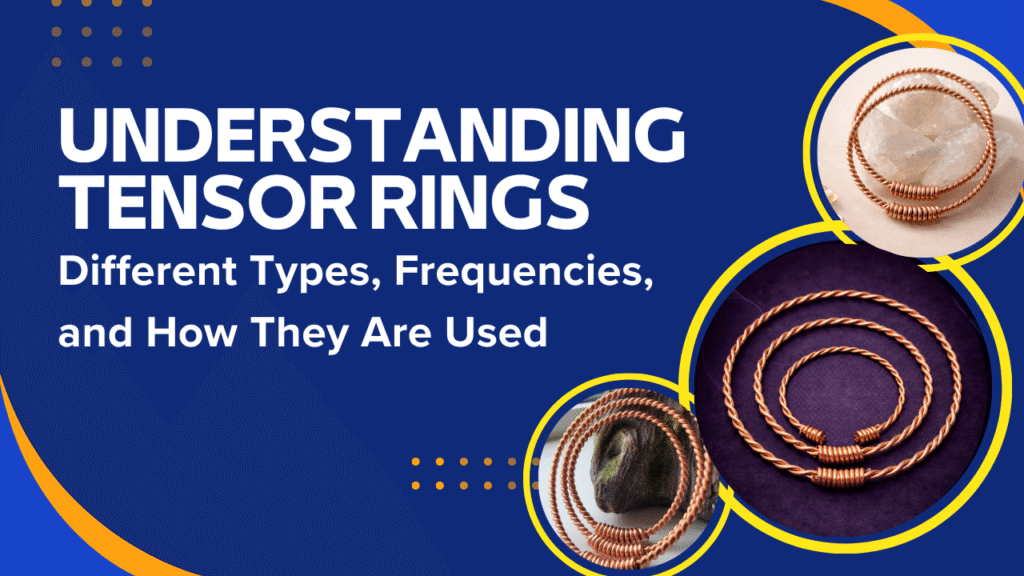
Understanding Tensor Rings: Different Types, Frequencies, and How They Are Used
What if something as simple as a metal ring could represent ideas about balance, structure, and continuity? Such a question is one of the reasons why people are attracted to Tensor Rings that have gained more and more popularity in the context of mindfulness and conscious living discussions.
Instead of being complicated device, these rings are based on simple geometry and material. However, the manner in which they are interpreted most notably in the frequency and design aspect introduces an element of curiosity that keeps people digging deeper into their interpretations.
In their simplest form, the use of tensor rings is frequently investigated as a representation of continuous flow. Their circular structure, with no beginning or end, symbolizes balance and uninterrupted movement. To a lot of users, this symbolic nature is as significant as their practical use.
The uniqueness of the tensor rings is in their classification, not only based on size or material, but also based on the number of cubits and the related concepts of frequencies. These types are debated extensively in circles where the subject of energy-related systems and geometry is studied.
In order to have a grasp of the concept of tensor rings, it is better to look beyond what is on the surface and to examine how they are organized, classified, and applied to the real world.
A Moderate View of Frequency and Usage.
Before diving deeper, it’s important to approach Tensor Rings with clarity. The concept of “frequency” in this context is not always defined in conventional scientific measurement terms. Rather, it tends to be employed as a symbol or concept in some wellness and alternative systems.
This article is for educational purposes only. It does not make medical or scientifically proven claims. In case you have any health-related issues, it is always advisable to seek the attention of a qualified professional.
Visualize the concept of tensor rings as an intention, structure, and environment tool, not a substitute to professional care or scientific solutions.
What Are Tensor Rings? Structure and Core Idea
Tensor rings are typically made by twisting metal wires—most commonly copper—into a continuous loop. The practitioners believe that the twisting process influence the conceptual behavior of the ring in terms of flow and structure.
Continuity is the important concept of the tensor rings. Since the ring does not have any endpoints, it is commonly linked to continuous movement or circulation. This concept is the basis of the interpretation and application of them.
From a structural perspective, they combine:
- Circular geometry (representing continuity)
- Conductive material (usually copper) that is twisted.
- Certain lengths of wire (connected to cubit measures).
This is what determines the identity of the tensor rings of various types.
Types of Tensor Rings by Cubit Length (Frequency Concept)
One of the most discussed aspects of Tensor Rings is their classification based on cubit lengths, which are believed to correspond to different “frequencies.” They are not standard scientific frequencies, but conceptual frameworks used in some communities.
Sacred Cubit (Approx. 144 MHz Conceptual Association)
One of the most popular types of cubit is the Sacred Cubit. It is commonly related to the grounding and balance.
Practically, this type is adopted by people who prefer to establish a stable and peaceful environment. It can be usually installed in residential premises or utilized in individual setups.
It is conceptually connected with:
- Grounding and stability
- Heart-centered awareness
- Creating a balanced environment
Lost Cubit (Approx. 177 MHz Conceptual Association)
The Lost Cubit has been said to be related to aspects of the mind and heart.
Those who explore into this type tend to tie it to introspection and reflection. It is occasionally used in meditation rooms where more attention is to be paid.
Theoretically, it is connected with:
- Emotional awareness
- Deeper reflection
- Expanded perception
Empowerment Cubit (Approx. 188 MHz Conceptual Association)
This form can be commonly linked to motivation and personal growth.
It is mostly applied in working or where concentration and development are valued. The concept is to help in embracing a more dynamic and progressive thinking.
Common associations include:
- Personal growth
- Confidence and focus
- Goal-oriented environments
Other Named Frequency Types.
In addition to the major cubits, other variations exist that are addressed in other communities:
- Viking Cubit – Viking Cubit is most commonly used symbolically to rest and to calm environments.
- Ra-Mu Cubit – Connected conceptually with ancient systems and traditional knowledge.
- Galactic or Ascension Rings – Applied in higher-level awareness and expanded thinking.
These frequency labels should be interpreted as conceptual frameworks, but not as quantifiable scientific values.
Types of Tensor Rings by Usage
The other practical method of knowing Tensor Rings is through their application in real-life situations.
Personal rings (Small Size)
They are small and can be carried or put on. There are people who carry them everywhere, as they are a part of their lives.
They may be:
- Worn as a pendant or a bracelet.
- Placed under pillows
- Stored on desks or workstations.
This is typically done to make one feel self-centered or regular.
Environmental Rings (Large Size)
Larger rings are typically used in spaces rather than on the body. They are put in certain locations to influence the general environment.
Common placements include:
- Near electronic devices
- In residential or business premises.
- And near the plants or water-bins.
They are frequently used on a personal preference and will of choice as opposed to quantifiable results.
Tool-Based Rings (Specialized Use)
There are rings that are specific to some uses in other practices.
These may include:
- Tools used in structured routines.
- Rings used with other objects.
- Configurations used for focused setups
Types by Structure and Material
The category of the tensor rings is also determined by their structure and their material.
Twisted Copper Rings
This is the most prevalent type. Copper is popular due to its conductive property and ability to shape.
The winding pattern is believed to be crucial in the establishment of the structure of the ring.
Plated Rings
Some rings are coated with metals such as gold or silver. This is usually done in order to be durable or to be attractive.
Coils and Spiral Variations.
Some designs contain spirals or coils, rather than a simple loop. These variations are employed in more speciated arrangements.
The structures provide a little variation in visual and functional orientation, depending on the way they are utilized.
Scientific vs Conceptual Understanding
The scientific knowledge and the conceptual interpretation should be kept apart when speaking of Tensor Rings.
Scientifically:
- The rings are tangible items composed of metal.
- They can conduct electricity due to their material
- They are based on simple geometric principles.
Conceptually:
- They are linked with symbolic frequency systems.
- Their utilization is in the formation of purposely designed environments.
- Their worth is usually subject to interpretation.
It is important to learn to see both sides of the coin when it comes to approaching tensor rings.
The Uses of Tensor Rings in the present.
Tensor Rings are simple but have deeper meaning and this is what makes them appealing. People are attracted to them due to various reasons.
Some have an interest in their symbolic structure. They are also used by others in mindfulness practices. Most of them just enjoy them as means of promoting mindful living.
They can be used in various lifestyles without involving complicated systems and instructions because of their versatility.
Common Misconceptions
Several misconceptions are to be cleared up.
Tensor rings are not scientifically tested to give definite results. They are not to substitute medical or professional advice. They are influenced by subjectivity and it requires individual interpretation.
Being aware of these issues will make it a more responsible and knowledgeable approach.
Conclusion
Tensor Rings offer an interesting blend of geometry, material, and conceptual meaning. Whether studied in terms of symbolism, structure design or as part of individual routine, they can be viewed as a distinctive method of how seemingly everyday objects can be overlaid with meanings.
The real value of them does not consist in the guaranteed results, but in the way of their usage and interpretation. They may be a part of a larger way of life of awareness, structure and purposeful living when approached in a thoughtful way.
Frequently Asked Question
- What are tensor rings made of?
They are normally produced using metals such as copper or aluminum.
- What does “cubit” mean in tensor rings?
It is the length of the wire used, which is associated with conceptual frequency systems.
- Are the frequencies of tensor rings scientifically proven?
No, they are grounded in the conceptual interpretations, instead of proven science.
- What are some applications of tensor rings?
They are applied in personal, environmental or symbolic systems.
- Is it possible to use tensor rings by beginners?
Yes, they are simple and can be used by any interested person.