
What Are Tensor Rings? Understanding Its Construction, Frequencies, and Uses
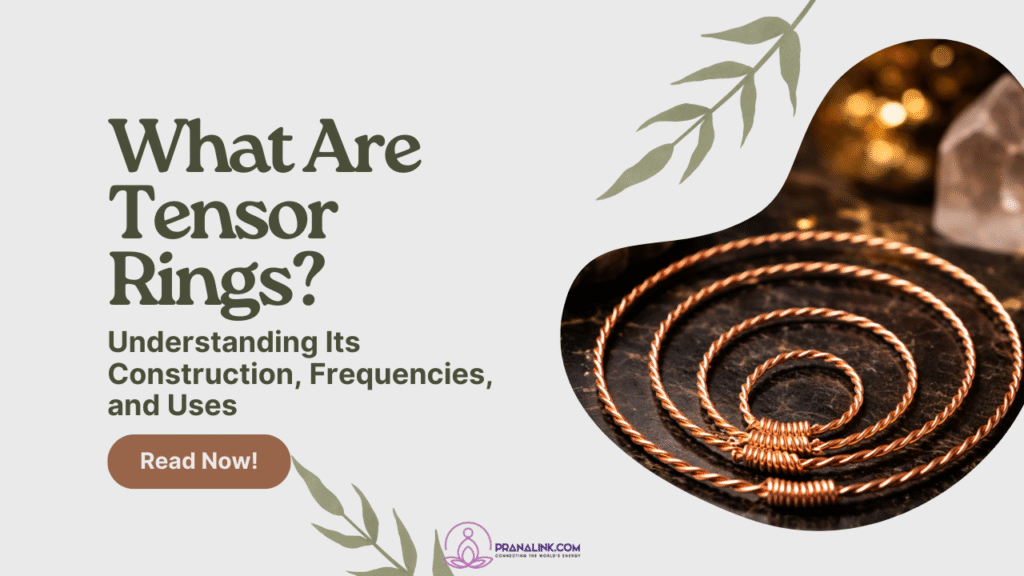
Tensor Rings are a precise geometric object made from specific lengths of copper wire shaped into a continuous closed loop. In tensor-ring practice, it is seen as a frequency-based tool. Its properties come from its material, measurement system, and geometry, not just intention. This article aims to explain what a tensor ring is, how it is made, what materials and measurements are used, how it is connected to frequencies, and how it is typically used in personal and environmental situations.
What a Tensor Ring Is
A Tensor Ring is a circular loop made up of solid copper wire, of a specific length determined by the use of ancient units of measurement known as cubits. After measuring, the wire is twisted into a circular loop, without any breaks or ends. This is crucial in the development of what we refer to as a stable tensor field.
Unlike symbolic objects, a tensor ring is all about the rules of physical construction. Its characteristics are directly linked to its dimensions and structure.
Materials Used in Tensor Rings
Tensor rings are crafted from copper, and this choice isn’t just for looks; it’s all about copper’s unique physical properties. Known for its excellent conductivity and stability, Copper is well-known for its conductivity and stability that deal with energy transmission and resonance for quite some time.
The wire used in these rings is solid copper, carefully chosen for its gauge to ensure both consistency and durability. Interestingly, tensor ring construction doesn’t involve any magnets, batteries, electronics, or coatings. The material itself is passive; what really matters is the specific geometry that’s created from it.
How Tensor Rings Are Made
The construction of a Tensor Ring follows a precise process:
- A specific cubit measurement is chosen
- The wire is twisted in a specific way
- Copper wire is cut to that exact length
- The twisted wire is bent into a perfect closed circle
The ends are joined together smoothly to maintain continuity. Once formed, the ring remains unchanged unless physically altered. Its frequency is seen as fixed since it is determined by the original wire length.
Cubits and Measurement Systems
Cubits are ancient units of length that were used in ancient architecture and engineering. There are different cubits from different cultures and eras, such as Egyptian, Near Eastern, and other ancient civilizations.
In tensor ring technology, every cubit corresponds to a certain length, and every length corresponds to a certain frequency. The accuracy of the measurement is crucial because even a slight variation will affect the frequency.
Frequency Generation in Tensor Rings
The frequency of a Tensor Ring comes from:
- The exact length of copper wire
- The twist applied to the wire
- The closed-loop shape
This configuration creates a self-sustaining field. The ring does not radiate energy; it maintains a fixed frequency that interacts with the surrounding fields. Different cubits generate different frequencies, which enable the creation of rings for different environments or purposes.
Historical Development
Contemporary tensor ring practice is inextricably linked with the work of Slim Spurling, who investigated ancient units of measurement and their use in the context of environmental energy ideas. This work has led to the rediscovery and standardization of cubit-based tensor rings and their use.
This is significant because it places tensor rings within a particular tradition rather than a generic or ad hoc idea.
Types of Cubits and Frequency Ranges
Each cubit is associated with a different range of frequencies. Some cubits are associated with well-known harmonic/sound-based frequency ranges, while others are associated with higher frequency ranges used in environmental and architectural applications.
Lower frequency cubits are generally used in grounding-related spaces. Mid-range frequencies are often associated with balance and stabilization. Higher frequency cubits are generally used in meditative spaces. These associations are based on practitioner use and long-term observation.
Use of Tensor Rings in Living Spaces
A Tensor Ring is commonly placed in a house in central locations, bedrooms, or quiet rooms. This is done to facilitate spatial coherence and balance. In other practices, rings are located near entrances or structural centers of buildings.
In gardens or outdoor spaces, tensor rings are used to facilitate harmonious environmental conditions around plant spaces.
Water-Related Uses
Tensor rings are commonly used around water containers. The tensor ring is placed around, below, or near a water container. This is based on the idea that water responds to structure and frequency.
The users have often reported changes in the perceived freshness or quality of the water. These are experiential and are part of lifestyle practices.
Use in Workspaces and Technology-Dense Areas
In offices or areas with electronic equipment, a Tensor Ring is typically placed near devices or within workspaces to manage and contain ambient radiation generated by electronic activity. In tensor-based practices, the ring’s continuous copper design and fixed frequency are linked to the creation of a stable field that affects how electromagnetic radiation is organized in the surrounding area.
This application is often part of larger initiatives aimed at maintaining organized and well-regulated work environments in settings with ongoing electronic use.
Responsible Context for Use
A Tensor Ring is not considered a medical device and is not meant for diagnosing, treating, or preventing any illness. It is used as a supplementary item in personal, environmental, or reflective practices.
Understanding its construction and limitations is essential for responsible use.
Conclusion
A Tensor Ring is a carefully crafted copper ring measured using traditional cubits and formed into a seamless loop. Its main characteristic is the frequency that results from its geometric shape and length. When properly designed and placed, tensor rings are used in homes, offices, water activities, and outdoor settings to create balance and harmony.
Frequently Asked Questions
1. How is a Tensor Ring normally used?
It is placed in a space like a room, office, garden, or near water.
2. Can a Tensor Ring be relocated after it is installed?
Yes. It can be relocated from one area to another as needed.
3. Is the size of a Tensor Ring important?
Yes. Different sizes are used depending on the space or application.
4. Is there any installation or activation of a Tensor Ring?
No. It is ready to use after placed.
5. Does a Tensor Ring deteriorate with time?
No. As long as it is in one piece, it will not change form.