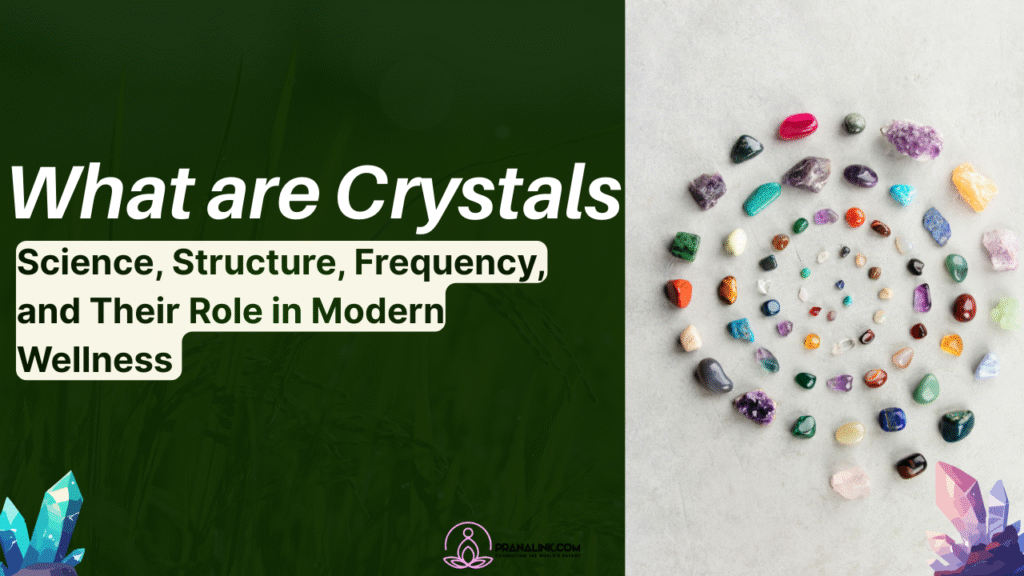
What are Crystals: Science, Structure, Frequency, and Their Role in Modern Wellness
Across cultures and generations, people have been fascinated by naturally formed minerals. Today, crystals appear not only in geology classrooms but also in wellness spaces, interior design, mindfulness environments, and technology industries. Their appeal spans science, aesthetics, and holistic living.
With growing interest comes a desire for clarity.
Are crystals simply beautiful stones?
Do they interact with energy?
Are claims about “frequency” scientific or symbolic?
This article explores “what are crystals” comprehensively — including their formation, structure, measurable physical properties, technological uses, wellness interpretations, and responsible sourcing — while clearly distinguishing scientific evidence from experiential perspectives.
What Are Crystals?
Crystals are solid minerals in which atoms are arranged in a highly organized, repeating three-dimensional pattern known as a crystal lattice. This internal symmetry determines their external shape, surface structure, and many physical properties.
Unlike most rocks, which are mixtures of irregular materials, crystals have consistent internal geometry. Familiar examples include quartz, amethyst, calcite, and feldspar.
This orderly structure is important both scientifically and aesthetically. It explains why crystals behave predictably in laboratory and technological settings and why their symmetry is visually appealing in design and wellness spaces.
How Crystals Form
Crystals form through natural geological processes that often take thousands or millions of years. They may develop as molten rock cools, mineral-rich water evaporates, or pressure and temperature change deep within the Earth.
Slower formation generally allows atoms to align more precisely, producing clearer and more structurally stable crystals.
Understanding formation is important because internal structure directly influences how crystals respond to physical forces such as heat, pressure, and electricity — properties that later become useful in science and engineering.
The Science of Frequency and Vibration
One of the most discussed aspects of crystals is “frequency.”
From a physics perspective, all matter vibrates at the atomic level. In crystals, atoms oscillate in stable, predictable patterns because of their ordered lattice structure. These vibrations are measurable and can be extremely consistent.
Some crystals — especially quartz — exhibit piezoelectricity, meaning they generate a small electrical charge when mechanical pressure is applied. Conversely, when an electrical signal is applied, they vibrate at precise, repeatable rates.
This property is not theoretical. It is widely used in modern technology, including:
• wristwatches
• radios
• communication devices
• medical instruments
• computer processors
Quartz oscillators, for example, help keep accurate time because their vibration rate is stable and predictable.
Importantly, these effects occur when crystals are physically integrated into electronic circuits. They do not emit significant energy into the surrounding environment on their own.
Crystals in Technology and Engineering
Certain crystals are essential components of modern electronics because their vibrational behavior can be precisely controlled.
In watches, they regulate time.
In communications equipment, they stabilize signals.
In sensors, they convert pressure into electrical information.
These applications show that crystals can interact with electrical energy when engineered into devices. However, this measurable behavior differs from broader wellness interpretations of “energy,” which refer to subjective or environmental experiences rather than electrical output.
Crystals and the Human Body: What Science Says
Because crystals have measurable physical properties, it is natural to wonder whether their frequencies directly affect the human body.
Current scientific evidence does not support the idea that crystals emit biologically active energy or radiate frequencies capable of influencing human tissues at a distance. Atomic vibrations stay confined within the material and are only useful when coupled into electronic systems.
For this reason, crystals are not recognized as medical tools or therapeutic devices.
That said, people may still experience meaningful benefits when using crystals in personal or wellness settings. These effects are generally understood to arise indirectly through psychological and environmental pathways rather than through measurable electromagnetic interactions.
Holistic and Experiential Perspectives
In holistic traditions, crystals are often associated with balance, intention, and connection to nature.
Rather than acting as energy emitters, crystals in these settings function more as environmental or symbolic elements. Their weight, texture, geometry, and natural origins can influence how a space feels and how a person focuses their attention.
Research in environmental psychology suggests that natural materials in living and working environments can:
• promote relaxation
• reduce perceived stress
• improve focus
• enhance mood
Crystals may contribute to these effects simply by serving as tactile, visual anchors that support mindfulness or intentional living.
In this way, any benefits are best understood as experiential and psychological — mediated by belief, meaning, and attention — rather than by direct physical energy transfer.
Around the world, crystals are placed in homes, studios, meditation rooms, and offices. They are typically used as design elements rather than treatments.
Crystals in Wellness Spaces
They are often combined with:
• natural lighting
• plants
• neutral color palettes
• minimalist layouts
Together, these features create calming environments.
The symmetry, smoothness, and natural colors of crystals can provide visual balance and a sense of grounding, helping people slow down and focus.
Psychological and Environmental Influence
Humans naturally respond to patterns, symmetry, and objects with personal meaning.
Holding or viewing a crystal during meditation may improve concentration simply because it provides a physical point of focus. Like a candle, stone, or piece of art, it can act as a cue for reflection.
These effects are better explained through attention and intention rather than through external forces or emissions.
Are Crystals Emitting Energy?
Scientifically, crystals respond to forces such as pressure, heat, and electricity. Some can generate electrical signals when mechanically stressed, but they do not continuously emit radiation or biologically active frequencies into their surroundings.
In wellness language, “energy” often describes emotional or environmental qualities rather than measurable physics.
Understanding this distinction helps avoid confusion between scientific properties and symbolic interpretations.
Cultural and Historical Significance
Crystals have long been valued for their durability, beauty, and symbolism. Ancient civilizations used them in tools, jewelry, architecture, and decorative art.
Their strength and permanence often inspired associations with stability, protection, and endurance — meanings that continue today in many cultures.
Ethical Sourcing and Environmental Awareness
As interest in crystals grows, responsible sourcing becomes increasingly important.
Ethical mining practices consider:
• environmental protection
• fair labor standards
• transparent supply chains
Consumers and businesses alike are seeking materials that align with sustainability and environmental responsibility.
Responsible sourcing supports both scientific credibility and ethical wellness practices.
Educational and Scientific Value
Crystals play an important role in geology, chemistry, and materials science education. Students study them to understand atomic bonding, mineral classification, and Earth’s geological processes.
Their predictable structure also makes them useful for laboratory research and technological innovation.
This educational role highlights their value as natural scientific materials in addition to their aesthetic appeal.
Crystals Within a Balanced Lifestyle
Crystals can be appreciated from several complementary perspectives.
Scientifically, they are minerals with measurable structural and electrical properties.
Technologically, they enable precision devices.
Aesthetically, they enhance design.
Experientially, they may support mindfulness and intention.
They are not substitutes for medical care or professional treatment, but they can be meaningful decorative or personal objects within a balanced lifestyle.
Conclusion
Crystals are naturally occurring minerals defined by ordered internal structures. These structures allow for predictable physical behaviors, including measurable vibrational properties that are widely used in technology.
At the same time, crystals are valued in wellness and design spaces for their symbolism, beauty, and ability to contribute to calming environments.
Understanding both perspectives — scientific and experiential — provides a clear and grounded view. Whether appreciated for geology, engineering, aesthetics, or mindfulness, crystals remain enduring symbols of order, structure, and connection to the natural world.
Frequently Asked Questions
1. What are crystals?
Crystals are natural minerals with repeating atomic structures that give them consistent shapes and physical properties.
2. Do crystals have frequencies?
Yes. All matter vibrates at the atomic level. Some crystals, such as quartz, have stable vibrational properties that are useful in electronics.
3. Do crystals emit energy that affects the body?
There is no scientific evidence that crystals emit biologically active energy. Reported benefits are generally explained through psychological or environmental factors.
4. Why are people drawn to crystals?
Many people appreciate their symmetry, natural beauty, geological history, and symbolic meanings.
5. Are crystals medical tools?
No. Crystals are not medical devices and should not replace professional healthcare.
6. How are crystals used in wellness spaces?
They are typically used as decorative or mindfulness objects that help create calm, intentional environments.
7. Are crystals scientifically studied?
Yes. They are extensively researched in geology, physics, chemistry, and materials science.